
Restaurant Owner's Guide to Outdoor Dining Pergolas: ROI, Design & Permits

For a restaurant operator, an outdoor dining pergola isn't a design upgrade — it's a revenue decision. Done right, a motorized louvered pergola adds usable covers per night, extends the dining season by months, and turns an underused patio into a signature space that defines the restaurant's brand. Done wrong, it becomes an expensive pavilion that's still empty when it rains and useless from October through April.
This guide walks through what restaurant owners actually need to know before investing in a commercial outdoor dining pergola: the ROI math, the design priorities that separate commercial from residential builds, the permitting reality across Massachusetts municipalities, and what to ask when you're evaluating installers.
The Real ROI Math on a Restaurant Pergola
Most restaurant patio investments are evaluated on a simple equation: cost of build divided by additional covers per year. The number that matters isn't the build cost — it's whether the patio actually generates additional covers in the months that previously sat dead.
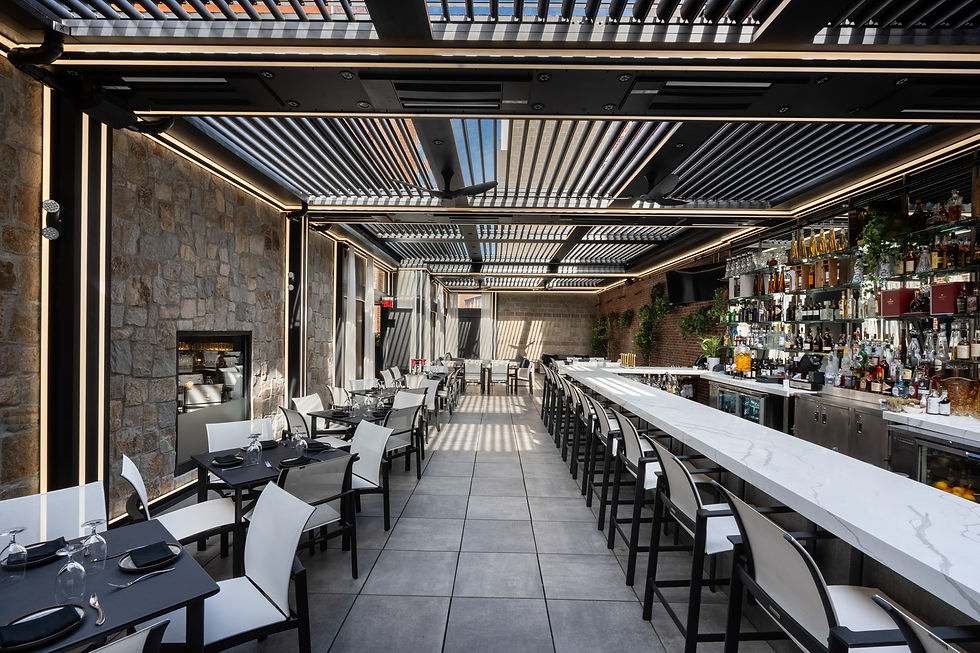
A traditional fixed-roof pergola or umbrella setup typically gives a restaurant three usable months: June, July, August. A properly equipped motorized louvered pergola — louvered roof, retractable screens, integrated heating, lighting — typically extends usable patio dining to seven or eight months: late April through October, with selective use in November and March on warmer days. That's roughly double the operational window.
The math compounds further when you account for weather flexibility. A traditional patio loses an entire night to rain. A motorized pergola closes its louvers in under a minute, sealing against rain mid-service, and dining continues uninterrupted. Restaurant operators we work with typically report recovering 15 to 25 service nights per year that would otherwise be lost to weather — nights that, on a busy patio, can represent meaningful revenue per occurrence.
Design Priorities for Commercial Pergolas
Commercial pergolas are not residential pergolas with bigger footprints. The design priorities are different, and the tradeoffs are different. A few that matter most:
Operational throughput. A residential pergola needs to look great. A commercial pergola needs to look great while supporting heavy daily traffic, frequent table turns, staff movement, and the wear of constant use. Materials, finishes, and structural specs all shift to commercial-grade.

Brand integration. The pergola becomes part of the restaurant's brand experience. The structure, the lighting design, the screen materials, the heating, the audio — every element either reinforces or undermines what the restaurant is trying to be. Our Umbria/Mia North End project is a case study in this — a 24-foot motorized sliding pergola system designed specifically to fit a historic North End rooftop while reinforcing the upscale steakhouse brand. So is our Eastern Standard installation in Fenway, where the pergola design directly reflects the restaurant's elevated, three-season vision for streetside dining.
Year-round versus three-season. A commercial pergola without integrated heating is essentially a three-season investment. With Infratech infrared heating, retractable screens, and overhead lighting designed for the early-sunset months, the same pergola becomes a year-round revenue line. The investment in the heating and screen systems usually pays for itself within the first shoulder season.
Permitting and code compliance. Commercial pergolas require building permits, and depending on the municipality, often require fire suppression review, ADA accessibility documentation, and structural engineering stamped by a licensed engineer. This isn't optional and isn't fast. Working with an installer who handles permitting in-house — rather than handing it back to the operator — is the difference between a six-week build timeline and a six-month one.
Permitting Across Massachusetts Municipalities
Massachusetts permitting for commercial pergolas varies meaningfully by town. Boston, Cambridge, Brookline, and Somerville all have distinct review processes — some require historic commission review for certain neighborhoods, some require zoning board approval for sidewalk-adjacent installations, and some require additional fire department review when integrated heating is part of the build. Suburban towns generally move faster but may have setback and lot-coverage restrictions that affect what's possible.
The practical takeaway for restaurant operators is simple: don't underestimate permitting. A typical commercial pergola permit timeline runs four to twelve weeks depending on the municipality and the complexity of the build. Plan accordingly, and make sure your installer is doing the legwork rather than handing you a stack of forms.
What to Ask When Evaluating Installers
If you're evaluating commercial pergola installers, the questions worth asking are less about the structure itself — most established installers can build a structurally sound pergola — and more about whether they understand restaurant operations.
Ask about commercial references, ideally in your specific category (restaurants, hotels, retail). Ask whether they've installed in your municipality before. Ask how they coordinate installation around active operations — most restaurants can't shut down for a four-week build. Ask about post-install service and maintenance: a motorized pergola has motors, sensors, and electronic components that will need attention over time, and whether the installer offers ongoing service like our Care+ maintenance program is the difference between a working system in year five and an expensive problem.
Ask about heating and screen integration specifically, because those are the systems that determine whether the pergola is a three-season feature or a year-round revenue line. Most residential-focused installers underspec heating; commercial-focused installers default to specifications sized for restaurant use.
The Bottom Line for Restaurant Owners
A commercial outdoor dining pergola is a revenue investment, not a design upgrade. The right build extends the dining season by months, recovers weather-lost service nights, increases capacity, and reinforces the restaurant's brand experience. The wrong build — undersized, underspecced, poorly engineered, missing permits — becomes a depreciating expense.
Boston Pergolas designs and installs commercial pergola systems for restaurants, hotels, and hospitality venues across Boston and New England. To explore a project for your venue, see our commercial pergolas for restaurants and hospitality page or request a commercial quote directly.


Comments